
Goal 5: Gender Equality
Goal 5: Gender Equality
Achieve gender equality and empower all women and girls

Introduction
Video Transcript – Goal 5: Gender Equality [PDF]
Learning Objectives
Knowledge-based objectives
- Understand the concepts of gender, gender equality, and gender discrimination, and their status at the local and global level.
- Understand the opportunities and benefits provided by full gender equality.
Interpersonal-based objectives
- Critically examine traditional perceptions of gender roles while respecting cultural diversity.
- Connect with others who work to end gender discrimination and violence, empower those who may still be disempowered, and promote respect and full equality on all levels.
Action-based objectives
- Identify ways in which the student can join efforts to promote gender equality.

How is Gender Equality Relevant to Sustainability?
The World Health Organization defines gender as the socially constructed characteristics and roles associated with being women, men, girls, and boys, including norms, behaviors, and relationships with each other. These characteristics can vary from society to society and can change over time, reflecting a complex interplay of biological, social, and personal factors. Gender is not a stand-alone variable, but intersects with a host of variables that can exacerbate inequalities. For example, ethnicity, age, and ability can impact access to healthcare, food, and social institutions such as social and legal services.
Sustainability Development Goal (SDG) 5 aims to establish gender equality and empower every woman. This goal is all about stopping the discrimination and violence directed at women of all ages, whether it happens out in the world or behind closed doors. It calls for the end of practices like child marriage and female genital mutilation, champions the sexual and reproductive rights of women, pushes for women to have equal seats at the leadership table, and demands that women have the same rights to financial and economic resources as men. Initiatives on this goal have been influential in shaping global and local policies and in mobilizing academic and research communities to focus on these pivotal issues.
Fostering gender equality has broad social benefits. When women have equal access to education, employment opportunities, and leadership roles, economies grow more rapidly. Gender equality in the workforce leads to increased productivity, innovation, and economic diversification. Gender equality brings more diverse perspectives to leadership roles, promoting innovation and promoting more resources for problem-solving. Gender equality also contributes to societal stability and resilience. Higher levels of gender equality are associated with a lower propensity for conflict within and between nations. Empowering women can lead to more sustainable resource management and conservation practices which promotes environmental sustainability. Gender equality in education leads to better maternal health, lower child mortality rates, and more sustainable family planning practices.
Measuring Gender Inequality
The United Nations Development Programme has developed a tool for measuring gender inequality called The Gender Inequality Index (GII). The GII is a comprehensive metric developed to evaluate gender disparities across different nations, focusing on three critical dimensions: reproductive health, empowerment, and labor market participation. Assessing reproductive health includes gathering and assessing data on, among other things, maternal mortality, pregnant women’s healthcare access, and the impact of early childbearing on education and health outcomes. Assessing empowerment involves examining the gender ratios of powerful social positions, such as parliamentary seats, and the levels of higher education attained. Assessing labor market participation involves examining women’s involvement in the workforce, including paid work, unpaid work, and job-seeking activities. The GII values range from 0 (indicating no inequality) to 1 (maximum inequality), offering a nuanced picture of how gender disparities can impact overall human development within a country. Countries with higher GII values exhibit more significant gender-based losses in human development potential.
Causes of Gender Discrimination
Interactive Infographic
Click on image for interactive elements

Link to the accessible version of this interactive content.
Ending Discrimination
Addressing gender-based discrimination includes addressing legal frameworks and policies that perpetuate gender inequality. This involves multifaceted strategies across different countries and sectors. Here are some specific examples and resources that illustrate how this issue is being tackled globally:
1. The U.S. government developed the National Strategy on Gender Equity and Equality, which outlines interconnected priorities across various sectors, including economic security, health, education, and justice. This comprehensive strategy also emphasizes an intersectional approach, acknowledging the compounded forms of discrimination experienced by various groups and outlining specific measures to address these challenges, such as improving economic security, preventing gender-based violence, and increasing access to healthcare.
2. The UN Women and IPU Handbook on Gender-Responsive Legislation is a notable resource for lawmakers. This handbook provides guidance for reforming existing laws and enacting new legislation to protect and empower women and girls. It includes case studies from around the world, showcasing successful legislative practices. For example, Malawi passed a law establishing 18 as the minimum age of marriage to combat child marriage, and Thailand adopted the Gender Equality Act to prohibit gender discrimination.
3. Canada addresses the use of pronouns as a measure to combat gender inequality by incorporating protections for gender identity and expression into its human rights laws. For example, the Ontario Human Rights Code was amended to include gender identity and expression, recognizing the right of individuals to be addressed by their chosen pronouns. This legal recognition extends to various areas such as employment, housing, and education, ensuring that individuals are respected and protected regardless of their gender identity. This approach reflects Canada’s broader commitment to promoting inclusivity and equality, recognizing the importance of acknowledging and respecting each person’s self-identified gender to combat gender-based discrimination and promote a more equitable society.
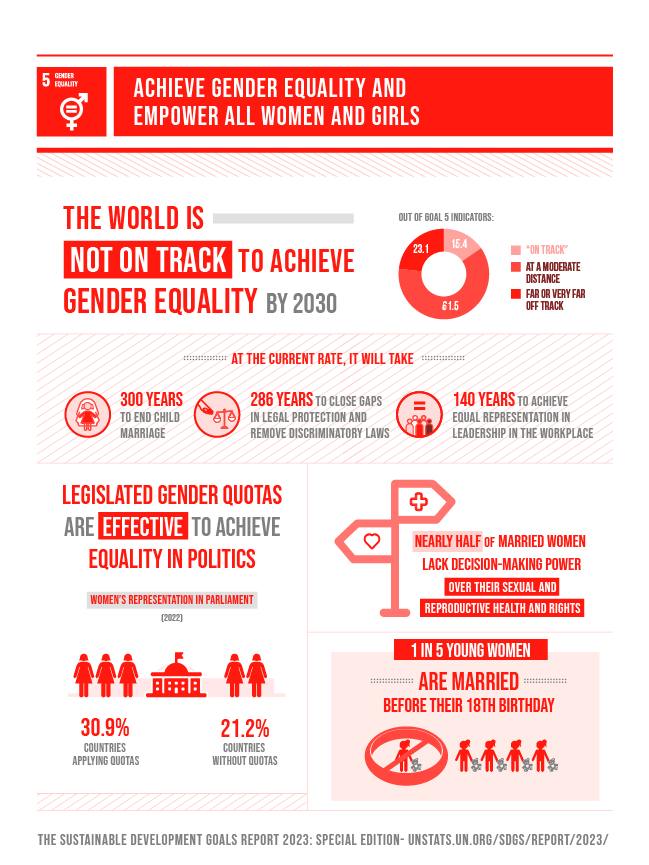
There are several challenges to meeting the targets of SDG 5. Entrenched gender norms and stereotypes, which perpetuate inequalities and limit women’s opportunities. Cultural and social norms dictate traditional gender roles, which results in unequal access to resources, decision-making power, and opportunities for women. Persistent economic disparities, including unequal pay and limited access to economic opportunities, which hinder women’s empowerment and economic independence. Insufficient investment in education, healthcare, and infrastructure, which exacerbates gender inequalities, particularly in marginalized communities. Conflicts, humanitarian crises, and natural disasters, which disproportionately affect women. Addressing these complex challenges requires coordinated efforts from governments, civil society, the private sector, and international organizations to implement comprehensive policies and programs that promote gender equality, empower women, and address underlying structural barriers.
Sustainable Development Goal 5 Targets
5.1 End all forms of discrimination against all women and girls everywhere
5.2 Eliminate all forms of violence against all women and girls in the public and private spheres, including trafficking and sexual and other types of exploitation
5.3 Eliminate all harmful practices, such as child, early and forced marriage and female genital mutilation
5.4 Recognize and value unpaid care and domestic work through the provision of public services, infrastructure and social protection policies and the promotion of shared responsibility within the household and the family as nationally appropriate
5.5 Ensure women’s full and effective participation and equal opportunities for leadership at all levels of decision-making in political, economic and public life
5.6 Ensure universal access to sexual and reproductive health and reproductive rights as agreed in accordance with the Program of Action of the International Conference on Population and Development and the Beijing Platform for Action and the outcome documents of their review conferences
5.A Undertake reforms to give women equal rights to economic resources, as well as access to ownership and control over land and other forms of property, financial services, inheritance and natural resources, in accordance with national laws
5.B Enhance the use of enabling technology, in particular information and communications technology, to promote the empowerment of women
5.C Adopt and strengthen sound policies and enforceable legislation for the promotion of gender equality and the empowerment of all women and girls at all levels
We are constantly trying to improve these resources. If you are interested in using these and have feedback for us, please contact Richard Plate (Richard.plate@ucf.edu).
Disclaimer: The content of this publication has not been approved by the United Nations and does not reflect the views of the United Nations or its officials or Member States.
