
Goal 12: Responsible Consumption and Production
Goal 12: Ways to Dig Deeper
Ensure sustainable consumption and production patterns

Background Information
Addressing challenges related to responsible consumption and production involves navigating issues such as peer pressure, sensitive topic trigger warnings, consumer spending, and shortages.
The impact of peer pressure, amplified by social media, on children’s thinking and mental health has prompted Seattle Public Schools to take legal action against social media giants like TikTok, Snap, Meta, and YouTube. The lawsuit alleges that these platforms contribute to a mental health crisis among students, emphasizing the need for responsible digital consumption.
Concerns about sensitive topics in academic settings have surfaced as Cornell University rejected a student resolution advocating for trigger warnings before introducing potentially sensitive content in classrooms. The university’s leadership sees this resolution as an infringement on academic freedom, echoing a broader debate around trigger warnings in education.
In the realm of civil rights and travel advisories, organizations like the Human Rights Campaign issue warnings about potential risks to minorities, immigrants, and LGBTQ travelers in Florida due to newly passed laws and policies. While not advocating for a blanket boycott, the advisory aims to draw attention to legislation perceived as hostile, emphasizing the importance of responsible decision-making in choosing travel destinations.

Illustration of a Worldwide Problem
The unsustainable pace of resource consumption globally is a significant concern. According to the Global Footprint Network, humanity uses resources 1.7 times faster than the Earth can regenerate, leading to environmental degradation and biodiversity loss. This overconsumption contributes to climate change, pollution, and resource depletion, threatening the planet’s ability to sustain future generations.
Developed countries, with their high levels of consumption and waste, are particularly culpable. In the United States, consumer spending has increased by 400% since 1970 [already said this], significantly impacting the environment. This trend emphasizes the need for a shift toward more sustainable consumption patterns to reduce emissions, pollution, and waste. Rethinking materialism and reducing the demand for goods are highlighted as crucial steps toward sustainability, with potential positive impacts on emissions, resource consumption, pollution, and mental health.
In developing countries, the challenges are different but equally pressing. These nations often face issues related to inefficient production processes, lack of infrastructure, and ineffective waste management systems, exacerbating environmental and health problems. For example, improper waste disposal and recycling practices contribute to pollution and health hazards in many urban areas. Addressing these issues requires international cooperation and investment in sustainable technologies and practices.
Furthermore, the instability of global supply chains, highlighted by the COVID-19 pandemic and regional conflicts, underscores the fragility of systems that support responsible production. Shortages of essential items, such as food and medical supplies, reveal the need for resilient and equitable supply chains that can withstand disruptions and ensure access to necessary goods for all populations. The imbalance in food supply, with some regions facing hunger while others experience abundance, calls for a more responsible and equitable approach to production and distribution.
Click on image for interactive infographic!
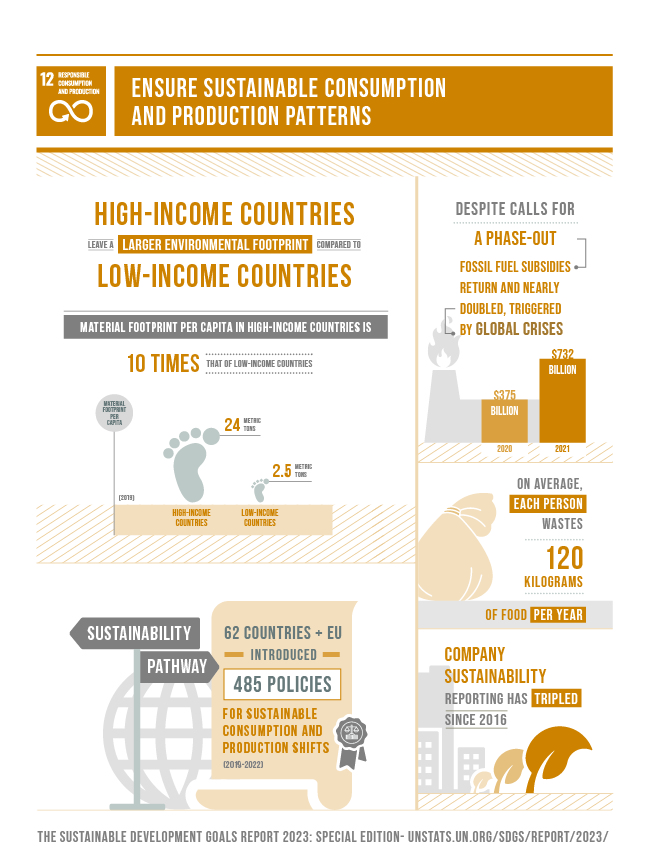
Link to Accessible Infographic
Florida-Specific Information
Florida, known for its diverse ecosystems and extensive coastline, faces significant environmental challenges, including waste management, resource conservation, and sustainable tourism. Addressing these issues is crucial for preserving the state’s natural resources and ensuring long-term economic and environmental sustainability.
One key area where Goal 12 is pertinent is in waste management. Florida produces a large amount of municipal solid waste, with over 28 million tons generated in 2018 alone. Proper waste management and recycling are essential to mitigate the environmental impact of this waste. By promoting sustainable consumption and reducing waste generation through recycling and reuse, Florida can decrease landfill use, reduce pollution, and conserve resources.
Another critical aspect is sustainable tourism. Florida’s economy heavily relies on tourism, with millions of visitors each year. This influx of tourists can strain natural resources and local infrastructure. Implementing sustainable tourism practices, such as promoting eco-friendly accommodations and reducing the environmental impact of tourist activities, aligns with Goal 12 and helps preserve Florida’s natural attractions for future generations.
Agriculture is also a significant industry in Florida, making responsible production practices vital. Sustainable farming techniques, such as organic farming and precision agriculture, can help reduce the environmental impact of agricultural activities. By optimizing resource use and minimizing waste, Florida’s agricultural sector can contribute to more sustainable food production and support Goal 12.
Additionally, the state’s coastal regions are vulnerable to climate change and rising sea levels. Sustainable consumption and production practices, such as reducing greenhouse gas emissions and promoting renewable energy, are essential to mitigate these impacts. Efforts to increase energy efficiency and transition to clean energy sources can help Florida address climate change while supporting Goal 12.
Orlando-Specific Information
As one of the most visited cities in the United States, Orlando attracts millions of tourists each year, which has significant implications for resource use and waste management.
With attractions like Walt Disney World and Universal Studios, the city sees a high influx of visitors, leading to increased waste production and energy consumption. By adopting sustainable tourism practices, such as promoting eco-friendly accommodations and reducing the environmental impact of tourist activities, Orlando can mitigate these effects and support Goal 12. For example, initiatives like Disney’s commitment to zero waste to landfill by 2030 exemplify efforts to align with sustainable consumption goals.
Many hotels and restaurants in Orlando have started to adopt sustainable practices, such as reducing food waste, using locally sourced ingredients, and implementing energy-efficient technologies. These efforts not only reduce the environmental footprint of these establishments but also promote a culture of sustainability among visitors and residents alike.
The city has also launched various initiatives to encourage recycling, reduce waste, and conserve energy. Programs like the “Green Works Orlando” initiative aim to transform Orlando into one of the most environmentally-friendly cities in the country. This includes efforts to increase recycling rates, promote energy efficiency, and support sustainable transportation options.
Orlando’s growing population and development pose challenges to sustainable resource management, and the city is working to address these challenges by promoting sustainable urban planning and development practices. This includes implementing green building standards, enhancing public transportation, and creating more green spaces.
UCF Initiatives
The University of Central Florida (UCF) has undertaken several initiatives aligned with Goal 12, focusing on responsible consumption and production to promote sustainability across campus operations and the broader community.
One significant initiative is UCF’s robust recycling and waste reduction program. The university has implemented comprehensive recycling efforts that include single-stream recycling, electronic waste recycling, and initiatives to reduce plastic use on campus. By promoting recycling and waste reduction, UCF aims to minimize the amount of waste sent to landfills.
UCF has also invested in sustainable food systems and responsible consumption practices in its dining services. The university partners with local farmers and suppliers to source fresh, locally-produced food, reducing the environmental impact associated with long-distance food transportation. Additionally, UCF dining services has implemented measures to reduce food waste, such as composting programs and initiatives to donate surplus food to local charities.
Energy conservation and efficiency are other key areas where UCF has made strides. The university has invested in energy-efficient infrastructure, including the installation of LED lighting and high-efficiency HVAC systems, and the building of automation systems that optimize energy use. These efforts reduce energy consumption and contribute to the university’s goal of achieving carbon neutrality.
Furthermore, UCF promotes sustainable transportation options to reduce the environmental impact of commuting. The university encourages the use of public transportation, biking, and carpooling through various programs and incentives. UCF’s shuttle service, the Pegasus Express, provides free transportation for students and staff, reducing the need for individual car use and lowering greenhouse gas emissions.
The university also offers numerous courses and programs focused on sustainability, environmental science, and responsible consumption. Through these educational opportunities, UCF aims to equip students with the knowledge and skills needed to address global sustainability challenges.
UCF Research
Here are some good topics for discussion regarding Goal 12, incorporating current news from various perspectives:
- Corporate Responsibility in Sustainability: The recent initiatives by major companies like Amazon and Walmart to reduce their carbon footprints and increase sustainability efforts make for an engaging discussion. Debates can revolve around the effectiveness of these initiatives, the transparency of corporate reporting, and the role of government regulation in ensuring corporate responsibility. Supporting article.
- Impact of Consumer Behavior on Sustainability: The rise in popularity of fast fashion and its environmental impact is a hot topic. Discussions can center on the consequences of disposable fashion, the role of consumer awareness in promoting sustainable fashion choices, and the effectiveness of campaigns aimed at reducing clothing waste. This can be tied to recent reports on the growing textile waste and the need for more sustainable production methods. Supporting article.
- Plastic Waste and Legislative Actions: Recent legislation aimed at reducing plastic waste, such as bans on single-use plastics, offers a rich area for discussion. Topics can include the impact of these bans on businesses and consumers, the effectiveness of such measures in reducing plastic pollution, and the potential for alternative materials. Supporting article.
- Food Waste Reduction Strategies: The increasing attention to food waste, with reduction initiatives from both governments and private organizations, provides a relevant discussion point. Topics could include the economic and environmental impacts of food waste, strategies for reducing food waste at both the consumer and producer levels, and the role of technology in addressing food waste. Supporting article.
- Sustainable Agriculture and Food Production: Sustainable agriculture practices, including organic farming, regenerative agriculture, and the use of technology in farming, provide engaging debate. Discussions can focus on the benefits and challenges of these practices, the impact on food security, and the role of government subsidies and policies in promoting sustainable agriculture. Supporting article.
- Renewable Energy and Resource Efficiency: Recent advancements and investments in renewable energy sources, such as solar and wind power, are a popular area of discussion. Discussions can delve into the potential of these technologies to meet global energy needs, the challenges of transitioning from fossil fuels, and the economic implications. Supporting article.
Additional Resources
We are constantly trying to improve these resources. If you are interested in using these and have feedback for us, please contact Richard Plate (Richard.plate@ucf.edu).
Disclaimer: The content of this publication has not been approved by the United Nations and does not reflect the views of the United Nations or its officials or Member States.
