Chapter 7: Policy Impact
Remember! No identifying information when discussing clients.
Please answer the following questions when creating your journal entry. Feel free to use references, share links, media, pics, and other items that you feel would help your teammates.
- How does your client’s current socioeconomic status (SES) or SES history impact their access to services? Does your agency have minimal income or maximum income a client can earn to receive services? Has your client’s SES impacted their need to receive services at your agency?
2. What systemic or legal policies/laws need to change to help your client move out of the current need for services? What can the client do, the agency do or the community at large do to assist in their need for services?
Student: Celia Walker
Agency: HOPE Helps
At HOPE, a client’s current socioeconomic status (SES) does impact their access to services. For clients to receive food at the pantry, their income must be 200% below the poverty line. Our agency does have a maximum and minimal income to receive services and the chart is below. Additionally, we are registered for the federal program titled Emergency Food Assistance Program (TEFAP) which provides emergency food assistance for clients within a specific poverty quota. A snippet of the income chart is below. All programs require the clients to submit their proof of income to confirm their need for services.
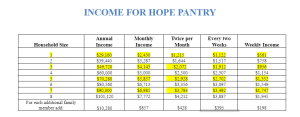 INCOME Chart: https://www.floridahealth.gov/diseases-and-conditions/aids/adap/_documents/2020FPL.pdf
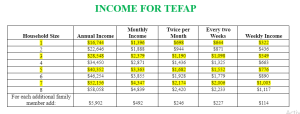 TEFAP:
 - Due to the increased cost of living, I believe that the federal government should increase the poverty line from 200% to 250% above the poverty line to receive services. From my experience, people at the 200% are struggling hard and require services to avoid homelessness. Once the change is made at the federal level, then HOPE can make the change to their policies. In doing so, clients can take advantage of the pantry and services to learn the skills and knowledge to be successful. Quick note, the agency is doing a great job, and the community will continue to increase volunteers to help other members of the community.
Reply(Lauren): My office runs very similar to you! Difference is that they have to prove low income for you but mine they are technically “referred” to us by the state because they are registered as indigent. I also completely agree that with inflation, if the cost of living continues to increase so should the poverty line. You are doing great work. 🙂
Reply (Jacob) Celia , I’m glad your agency does a lot to help your clients. It is sad that poverty keeps on growing. While no one at my internship is homeless there are a lot or other things that are preventing their needs from being met. It is important that we continue to fight and advocate for our clients.
Student: Lauren Frank
Agency: Office of Criminal Conflict and Civil Regional Counsel
1. Our office works with indigent clients so they are provided with our services regardless of their socioeconomic statuses. They will be provided counsel no matter their income and financial status. If and when they are given a case plan (dependency cases), then when we are going over what services they need to complete for the court there might be restrictions based on their income but most places work with our clients. Also based on case plans, they are required to show proof of income and housing.
2. Many of my clients need assistance in their case plans and finding jobs that can sustain themselves and their children. The other most difficult service to provide is helping clients find housing when they only receive social security or are searching for a job while also searching for housing. Extra services in these areas would be super helpful with our clients. Recently we went to the Sharing Center to see what resources they provide and they have expanded so much and so many resources such as food pantry, thrift shop, job training, and more. I will put the link below!
https://thesharingcenter.org/ourmission/
Reply(Lauren): Thank you for sharing. A resource that may help the clients at your Internship is Christian HELP Employment & Resource Center. They can help clients find jobs and appointments are done virtually at https://business.owsrcc.org/list/member/christian-help-employment-resource-center-6010. I hope you are enjoying the learning experience.
Reply (Jacob) Lauren , this is a really good resource. I should bring this up at my internship. I might consider sharing it in the future as well!! I wish more people were aware that these programs existed.
Student: Jacob Glofka
Agency : Brevard Public Schools
- Being an intern at the South Alternative Learning Center in Melbourne, Florida, has allowed me to understand how the present socio-economic status or history of income status plays a significant role in access to services. The center has established specific income limits to verify the eligibility for services targeted at those who need it more. Although different SES groups experience various obstacles in accessing education, employment, and other resources, the low SES populations are more likely to need services due to the lack of resources in their life.
https://datausa.io/profile/geo/melbourne-fl/
- Our Center is dedicated to tackling the systemic constraints that sustain the cycle of poverty and social injustice. It is essential to advocate for policy changes to support clients in having access to services and being able to leave the situations that have led them to seek help. Reforming education, training, affordable housing options, and healthcare access are essential measures to empower individuals to wage the war against poverty. The process of advocating for systemic changes is accompanied by actions that clients, our agency, and the community can take, which are also helpful in tackling the shortage of services. The client’s sense of empowerment can be bolstered by actively participating in educational and vocational programs, thus improving their skills and employability. As the agency, we can develop individual service support and work with educational institutions to satisfy our clients’ needs. Community involvement is also critical; that being said, I am committed to collaborating with local organizations, businesses, and community leaders to form a conducive environment.
https://pinellas.gov/federal-poverty-level-income-guidelines/