
Chapter 13: Barriers to Care from the PIE Perspective
Remember! No identifying information when discussing clients.
Please answer the following questions when creating your journal entry. Feel free to use references, share links, media, pics, and other items that you feel would help your teammates.
- Take a look at this Identity Wheel:
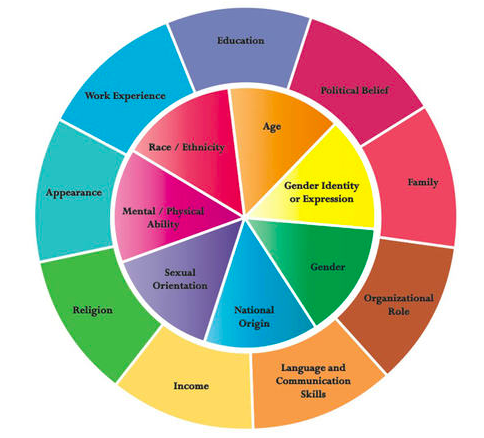
- What factors in your client’s environment (home, school, work, socioeconomic group, ethnic or racial culture group, religion, etc.) provide benefits and strengths for reaching outcomes, and which ones may impact or hinder outcomes? Are there any that may do both (assist and hinder)?
- Which of the above factors do you feel most inform your work as a social worker and why?
Alicia Henry
Orlando Health-Health Central
When it comes to the clients I assist, the most prevalent barriers to addressing their needs are income, as well as mental and physical abilities. As an inpatient discharge planner in the healthcare setting, a patient’s socioeconomic situation influences the level of care and treatment they receive. Their lack of or low income contributes to them being uninsured or underinsured, limiting their ability to meet their medical needs. The poor income and lack of income also affect their ability to care for themselves emotionally and physically.
I’ve found that having support from their families and church organizations has been a source of strength. Many patients are supported by their families, who help them meet their needs in a variety of ways, including advocating for them to ensure that they are heard and receive the best available care. Patients with a church family receive assistance from the pastor and church members who pay them visits while they are in the hospital and offer prayers and encouragement.
Income, again, can be both a hindrance and a benefit. Patients with a high income will have enough medical coverage and be able to access resources for ongoing care. A patient with low or no income is just the contrary; because they are uninsured or underinsured, they do not obtain adequate or ongoing care and must deal with the social determinants of health.
As a social worker intern and in my professional employment, I would have to agree that all of these factors are important since social workers consider the whole individual. Each of these factors can influence how we serve our clients and guarantee that we are doing it in the most effective way possible based on their needs.
Alicia- I notice that clients with a supportive community tend to do a lot better than those without one. Many times this is a faith community, but it can also be sports, interest-based, neighborhood, or other types of community. A significant part of our jobs as social workers is helping our clients build a support system around themselves. I’m sure that in the medical setting, social support is not only helpful, but it is vital to make sure that the patient is being advocated for! -Polly
Elizabeth Prophete
Orlando Health REACH
- What factors in your client’s environment (home, school, work, socioeconomic group, ethnic or racial culture group, religion, etc.) provide benefits and strengths for reaching outcomes, and which ones may impact or hinder outcomes? Are there any that may do both (assist and hinder)?
When it comes to most clients that I serve, a common factor that can hinder my client’s outcomes would be their race and ethnicity. Working in a healthcare setting, one of the issues is the disparities within healthcare. Majority of my clients are minorities (black/African American and Hispanics) and due to their race and ethnicity, obtaining insurance, affordable healthcare and or quality healthcare can be very challenging especially when they are not US citizens and new to the state. Not only can it be hindering in the terms of obtaining appropriate healthcare, but also it can lead to language barriers which makes it difficult for clients to communicate about their wants and needs. Race and ethnicity can also play a major role on how clients perceive a medical or mental health issues and what treatment looks likes.
When it comes to a factor that is beneficial, I strongly believe that it is education. Education can provide opportunities for clients. The higher the education, the more opportunities there are. I am not fully aware of the statistics, but people who are educated are more likely to obtain a job and have access to medical care.
A factor that can both hindering and be beneficial would-be family. I am a strong believer that one’s environment plays a major role on how successful and or unsuccessful an individual can be. I have seen clients who have support from their family which can help alleviate their current medical crisis/trauma that they are experiencing. Then there is the opposite, where the family can cause more harm than good due to their lack of support, and this can prolong the client’s improvement.
- Which of the above factors do you feel most inform your work as a social worker and why?
I do not quite understand this question and think the wording is a bit off. But what I am assuming is the question is asking which factor is observed more within my line of work as a SW. To be honest, I feel that all the factors listed above are. Evey family/client that I sever is different from the other and I have experience each and every one of these factors as with positive and or negative. I have witnessed it as a DCF worker, Dependency Case Manager and at my current internship here at REACH.
Here is a video of SDOH
Social Determinants of Health: Claire Pomeroy at TEDxUCDavis (youtube.com)
@Elizabeth- I wholeheartedly believe that family is an important aspect of who we are, and it can be both a source of strength and a barrier to who we are and who we become. I’ve learned that as children, our parents/family serve as our models, and they can be either positive or negative. The model they establish influences how we develop as adults.-Alicia
Elizabeth- I’m sure you are right about how one’s education impacts their ability to access healthcare. I know a gentleman who was in and out of the hospital for a month and had a hard time advocating for himself because of how he looks and what he sounds like. I believe he left school after eighth grade, always worked manual labor jobs, he looks a bit scruff, and he has a very thick Southern accent and mumbles a bit. A family member of his talked to me and was saying that he thinks the medical staff assumed that he wasn’t “worthy” of high quality care based on their assumptions of him. But like you said, family is a key factor. He was finally able to get the care he needed because his family advocated for him! I think in the hospital setting, social workers can do this same kind of work to advocate for patients to medical staff and make sure that the care they receive is not dependent on assumptions about them. -Polly
Name: Polly Smith
Agency: Seminole County Public Schools
- What factors in your client’s environment (home, school, work, socioeconomic group, ethnic or racial culture group, religion, etc.) provide benefits and strengths for reaching outcomes, and which ones may impact or hinder outcomes? Are there any that may do both (assist and hinder)?
The students and their families at my internship placement come from a variety of backgrounds, but most are low-income. Interestingly, these families seem to have almost no social support. Talking with the school social worker, I learned that they have tried to connect families with one another to build social support, but the families have been very hesitant to trust others. I think the aspect of living in poverty AND having almost no support system is the most detrimental factor for these families. Additionally, many families experience systemic injustice due to their race, national origin, socioeconomic background, and mental/physical abilities. If families have a modest income OR a robust support system, they tend to do well in terms of housing security, getting their kids to school, meeting their kids’ basic needs, etc.
On the positive side, when students and their families are supported by their religious community, family, or other community involvement, they seem to have better outcomes. Some of the families we see are also motivated to work on their education and careers to improve their financial stability. When families have good communication skills and are proficient in English or Spanish, they also tend to see good outcomes for themselves and their children.
- Which of the above factors do you feel most inform your work as a social worker and why?
All these factors inform my role as a social worker, even those I think about less often (such as religion or national origin). Recently I have been reflecting on how my disabilities impact my work, so I’ll focus on that. I am someone with both visible and invisible disabilities. While there are a lot of ways that my disabilities make work harder, I truly don’t think that I could be as effective of a social worker without them.
My life experiences add value to the work. I can connect with clients in a way that would be impossible to do without having lived in this body and with this brain. My life experiences inform my work as a social worker because I tend to think a bit differently, and I’m used to finding creative solutions to problems.
The most rewarding part of my work (during internship or at my job) is when clients feel like they can be their authentic selves with me, or when they finally feel seen. I also know how to support others because I have been supported by others (therapist, financial coach, ADHD coach, professional organizer, mental health support groups). Having a shared language and similar experiences with clients is something that you can’t learn from a book.
This is just one of the many factors that inform my work, but I chose to talk about it because I don’t often hear discussion about disability as it relates to this work.
I think I have mentioned it before, but there’s a beautiful documentary called Crip Camp about some amazing individuals and organizations that fought for disability rights. It’s informative, funny, and moving. I think it should be a must-watch for social workers since it shows amazing advocacy strategies, creative accommodations, and how marginalized groups can work together to fight for change that helps us all.
To watch: Crip Camp (you can also watch the short trailer if you don’t want to commit to the full-length documentary!)
@ Polly- The fact that your life experience brings value and allows you to connect with and relate to the issues that your clients face is far more useful than anything that can be learned from a textbook. When clients feel that we actually understand what they are going through because of our own personal experiences, they are more willing to let down their guard and accept that we, as social workers, genuinely care about them.- Alicia
@Polly- Yes, I agree with you about income and how it can provide some form of support as far as housing etc for the families. I also agree with Alicia. I love that your clients feels they can be their authentic self when they are around you. That says a lot about what you are doing and how much pass you have for what you’re doing. – Elizabeth
@Alicia- I am with you 100%. Like I had mentioned All of these factors are important. Have if a better understanding on how these factors impact each client is also key in finding a way to support them.